



Leadership, sustainable water innovation and the commercial case for better shower- water management across the GCC
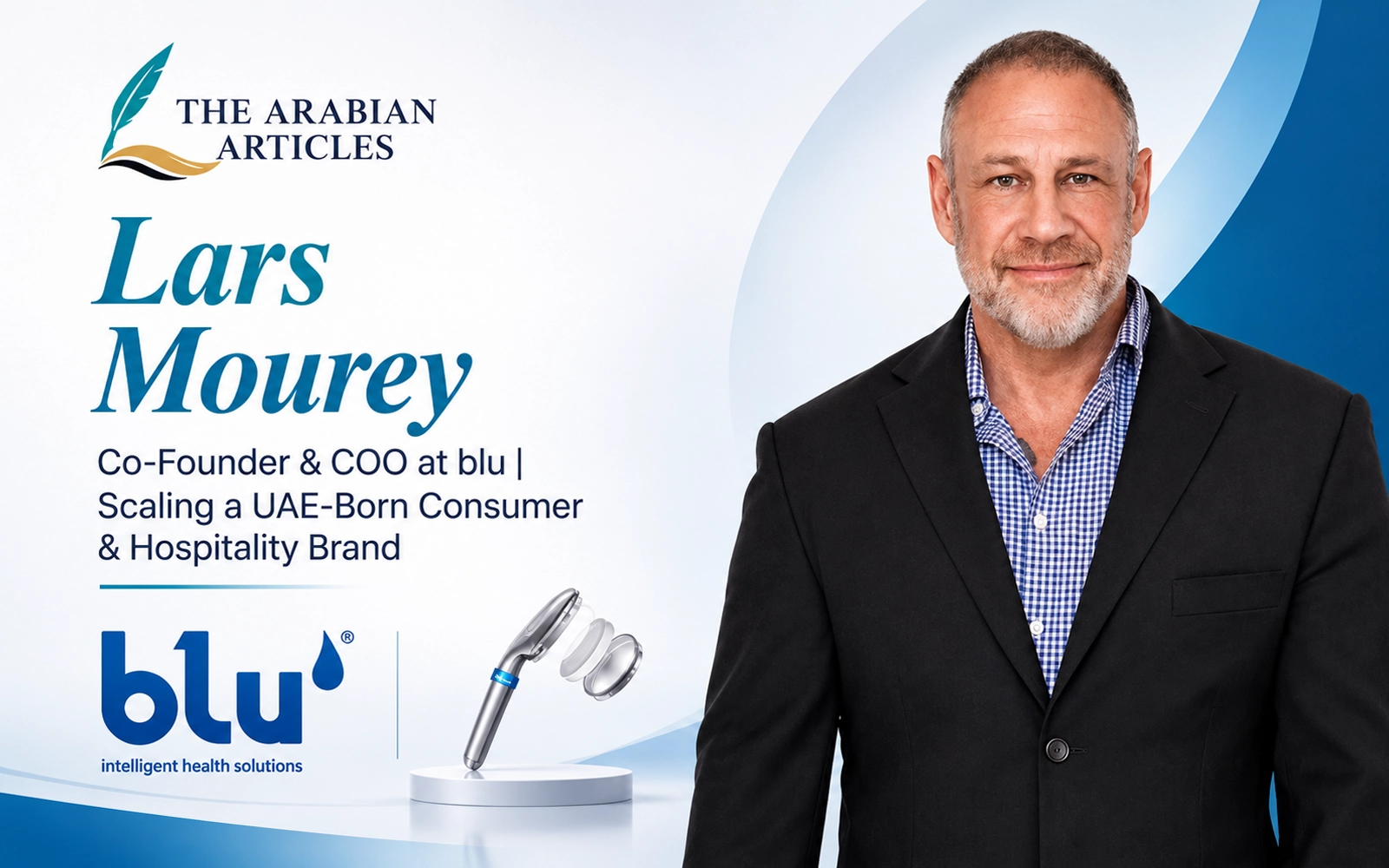
Lars Mourey is Founding Partner of blu Intelligent Health Solutions, a Dubai-founded company operating across consumer retail, e-commerce and hospitality. Together with CEO Ahmed Elgibaly, he has helped develop blu since 2009 around a simple commercial principle: identify a genuine customer problem, build a solution that delivers measurable value, and protect the customer experience while doing it.
That philosophy increasingly shapes blu’s hospitality business. In hotels, shower-water efficiency can deliver environmental benefits while also reducing operating costs and the energy required to heat water — but only if the guest experience is protected. For Mourey, that is where sustainability becomes commercially interesting: when responsible resource use, customer experience and financial performance reinforce one another.
Building Blu Around Real Customer ProblemsBlu – Lars Mourey
blu was founded in Dubai in 2009. The company’s earliest work focused on the final stage of the shower-water journey and on improving the everyday shower experience at the point of use. Over time, that focus expanded into a broader business spanning consumer products, e-commerce, physical retail and hospitality.
For consumers, blu is known for the blu Shower & Filter, a combined shower and point-of-use filtration system. The product has given the company a direct connection with customers at scale, and Mourey believes that connection is one of blu’s most valuable sources of business intelligence.
What customers buy, what they buy again, what they complain about, what they recommend, and where they experience friction all influence product development, communication and service. Mourey’s view is straightforward: businesses should listen to actual customer behaviour before relying on assumptions made in a meeting room.
That customer-first discipline has helped blu grow into a regional business with more than one million blu products sold across the GCC and a large body of customer feedback across its direct channels and regional marketplaces. For Mourey, scale matters less as a headline than as a source of evidence about what customers genuinely value.
From Consumer Showers to Hospitality Water Efficiency – Lars Mourey
Hospitality presents a very different challenge from consumer retail. A hotel is not simply choosing a showerhead. Owners, operators, engineering teams, finance, procurement, and housekeeping all look at the same product from different angles: guest comfort, flow and pressure, maintenance, reliability, operating cost, warranty, installation, and long-term service.
blu’s hospitality water-efficiency solutions are therefore built around the conditions of the individual property rather than a single standard specification. The starting point is not “Which product do we want to sell?” but “What does this property actually need?”
That distinction is important because the opportunity varies considerably from hotel to hotel. A property replacing a very high-flow shower has a different business case from one that has already invested in efficient fixtures. Water pressure, shower configuration, room type, occupancy and existing flow rates can all materially affect the outcome.
Why the Hotel Shower Matters – Lars Mourey
Hotels have made significant progress in areas such as HVAC efficiency, lighting, food waste, linen programs and renewable energy. The guest-room shower can receive less attention, yet it combines several operating costs at once.
There is the water itself. There is the energy required to heat a substantial portion of that water. There are wastewater costs, fixture maintenance, and replacement considerations. And, critically, there is guest satisfaction.
For Mourey, this last point is what makes hospitality water efficiency different from a simple conservation exercise. A hotel can install an extremely low-flow shower and achieve an impressive theoretical saving, but if guests dislike the experience, the solution has failed commercially. The objective is not to use the least water possible. It is to find the right balance for the property.
Measurement Before Recommendation – Lars Mourey
blu’s hospitality work typically begins with a site evaluation. The team reviews the existing shower configuration, measures flow and pressure, considers the room types, and assesses the operational requirements of the property before recommending a solution.
Where appropriate, pilot installations allow engineering teams to compare actual performance and give the property an opportunity to evaluate the guest experience before a wider rollout. Potential savings can then be assessed against the hotel’s own operating conditions, including room count, occupancy, existing flow rates, water tariffs and water-heating costs, rather than relying only on generic industry assumptions.
blu assesses potential shower-water savings by comparing existing and proposed flow rates under the property’s operating conditions. Actual consumption savings also depend on shower duration and usage, so the company avoids promising the same percentage saving to every hotel.
For Mourey, the question should not be what a brochure says a hotel can save. The question should be what can be demonstrated at that hotel.
The Second Saving: Water-Heating Energy
Reducing shower-water consumption can create a second operational benefit that is easy to overlook: less water may also mean less energy is required to heat that water.
Across a single household shower, the difference may appear modest. Across hundreds of hotel rooms operating every day, the cumulative impact can become significant. This is why blu’s hospitality business cases consider both water reduction and the associated water-heating energy where the necessary property data is available.
The commercial logic is important. A sustainability initiative supported by a credible operating saving and a realistic payback period competes differently for capital than one based primarily on good intentions. Mourey believes this is one reason practical efficiency projects can scale: the environmental and financial arguments can point in the same direction.
Filtration and Water Efficiency Solve Different Problems
One area where blu is careful to draw a distinction is between shower-water filtration and water efficiency. The two can complement one another, but they are not the same function.
The consumer blu Shower & Filter uses blu’s proprietary NMC filtration medium for point-of-use shower filtration. The NMC filtration medium is certified to NSF/ANSI 42. SGS, TÜV and Eurofins independently tested the assembled filter. That proposition is primarily concerned with the quality of the water reaching the user at the showerhead and with the shower experience itself.
Hospitality water efficiency is a different commercial proposition. Hotels can deploy blu’s flow-control and shower engineering without automatically requiring the consumer NMC cartridge. Depending on the project, hospitality configurations may focus primarily on controlled flow, water and energy efficiency, practical maintenance, and the operating conditions of the individual property.
For Mourey, the distinction reflects a broader business discipline: do not solve a problem the customer does not have. A hotel looking primarily for water and energy efficiency should receive an efficiency solution. A consumer concerned about point-of-use shower filtration has a different need.
Sustainability Has to Make Commercial Sense
Mourey’s leadership approach is strongly commercial but deliberately long-term. Revenue matters, but he does not believe revenue alone defines a healthy business. Profitability, disciplined cash flow, product quality, customer trust, and durable relationships all matter.
That philosophy is particularly relevant in hospitality, where sales cycles can be long and decisions involve multiple stakeholders. A general manager may focus on sustainability and guest experience. An engineering director sees pressure, flow, reliability, and maintenance. Finance sees investment, operating savings, and payback. Procurement sees specification, price, warranty, and service.
A successful proposition has to make sense to all of them. The objective is not simply to win an initial order, but to create enough value that the property is comfortable expanding the installation, returning for future projects, and recommending the solution elsewhere.
Partnerships That Create Tangible Value
Strategic partnerships are central to blu’s ambitions across the UAE and wider GCC, but Mourey is selective about what a partnership should actually contribute.
He believes successful partnerships should create tangible value for both sides — whether through market access, distribution capability, customer relationships, technical expertise, local knowledge, or another clearly defined advantage. Partnership for its own sake is not the objective; the relationship should make the combined proposition stronger than either side could deliver alone.
That same long-term mindset applies to customer relationships. Short-term revenue should not come at the expense of the reputation and trust required to build a durable regional business.
The Future of Water Efficiency Across the GCC
Mourey sees significant opportunity across the UAE and wider Gulf region as hotels, residential developments and other large-scale properties place greater emphasis on measurable water efficiency and operating performance.
He is particularly interested in better measurement. The more accurately properties can understand actual water use at the point of consumption, the easier it becomes to move sustainability discussions from estimates to operating data. Better metering, improved data, and continued innovation in shower systems can help property owners understand the real impact of efficiency initiatives rather than relying only on theoretical savings.
For blu, that creates an opportunity to combine engineering, measurement, and customer experience practically. The company’s role is not simply to sell a water-saving product, but to help the customer understand whether the solution works in the conditions of that particular property.
When Better Sustainability and Better Economics Point in the Same Direction
For Lars Mourey, practical sustainability becomes easier to scale when environmental performance, customer experience, and commercial economics reinforce one another.
A hotel should not have to choose between reducing water consumption and maintaining a premium guest experience. An engineering team should not have to choose between efficiency and practical maintenance. And an owner should not have to choose between sustainability and financial return when good engineering can potentially deliver both.
That is the opportunity Mourey sees for blu across the UAE and the wider GCC: making better management of shower water part of everyday business rather than something customers or hotels have to compromise to achieve.
𝐂𝐨𝐧𝐧𝐞𝐜𝐭 𝐰𝐢𝐭𝐡 𝐋𝐚𝐫𝐬 𝐌𝐨𝐮𝐫𝐞𝐲
Read More :-
Babajide Ogunseinde, MD, MBA: Inaugural NASS Distinguished Fellow Advancing Spine Care
Building Sustainable Pharmaceutical Partnerships Across Global Markets
Driven by Distraction: Turning ADHD Traits Into a Visionary Leadership Advantage