


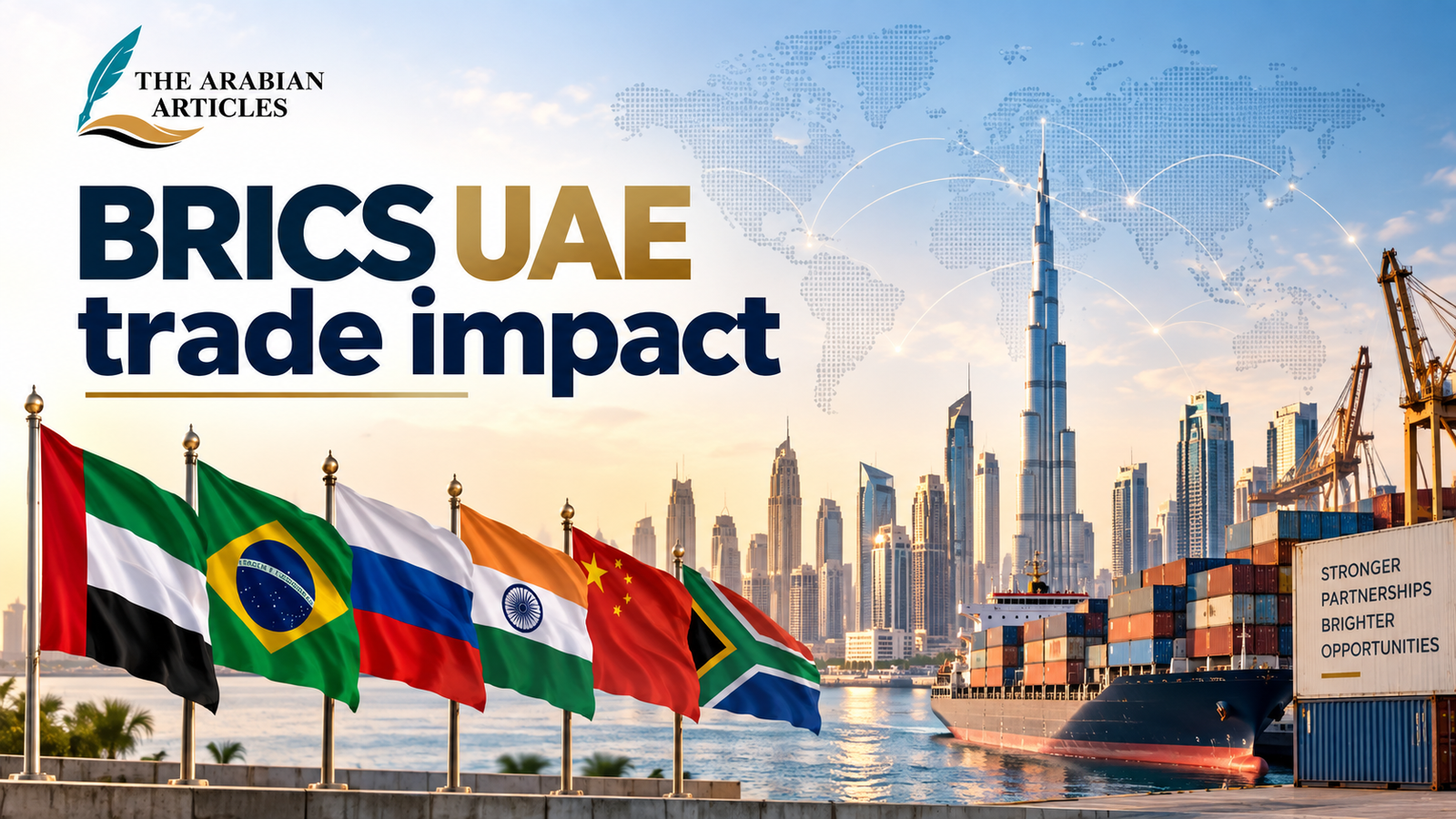

The BRICS UAE trade impact isn’t a future prediction anymore — it’s already showing up in the numbers. The UAE joined BRICS as a full member back in January 2024, and by the time leaders gathered in New Delhi for the 18th BRICS Summit this September, the country’s non-oil trade with fellow BRICS members had crossed $312 billion for 2025, up from $243 billion the year before. That’s nearly 29% growth in a single year, and it’s forcing a real conversation about how much this membership is actually reshaping UAE trade.
Why BRICS Membership Matters for the UAE
BRICS isn’t a small club anymore. Member countries together account for close to half the world’s population, nearly 40% of global GDP, and roughly a quarter of global trade. For a country like the UAE, which has spent the last decade aggressively diversifying away from oil, being inside that bloc isn’t symbolic — it’s a practical way to plug into new trade corridors, investment channels, and partnerships with economies growing faster than traditional Western markets.
BRICS countries now make up around 31% of the UAE’s total non-oil foreign trade, 34% of its imports, and 28% of its re-exports. That’s a significant chunk of the economy now tied to a group the UAE has only formally belonged to for less than two years.
Where the Growth Is Actually Coming From
The trade numbers aren’t spread evenly — a handful of relationships are doing most of the work.
China is the UAE’s single largest BRICS trading partner. Non-oil trade between the two countries hit $111.5 billion in 2025, up 24.5%, crossing the $100 billion mark for the first time. That growth is being driven by expanding cooperation across trade, investment, technology, and logistics — not just one sector.
India comes in close behind, helped enormously by the UAE-India Comprehensive Economic Partnership Agreement (CEPA), which has made bilateral trade meaningfully easier. Non-oil trade with India reached AED 107.5 billion in just the first half of 2026 alone.
Russia is the standout growth story. Non-oil trade between the UAE and Russia jumped 77.7% in 2025 to reach $20.4 billion — nearly double the previous year — helped by a new Trade in Services and Investment Agreement and the UAE’s broader Comprehensive Economic Partnership Agreement with the Eurasian Economic Union.
Brazil, while smaller in absolute terms, crossed $5.4 billion in bilateral trade, with cooperation expanding into infrastructure and investment as well.
The De-Dollarization Angle
One of the more consequential shifts tied to BRICS membership is less about trade volume and more about currency. BRICS has been actively pushing trade settlement in local currencies rather than the US dollar, and the UAE’s participation gives it a stake in that shift. For UAE businesses, this could mean more flexibility in how cross-border payments with BRICS partners are settled over time — reducing exposure to dollar fluctuations and potentially cutting transaction costs on major trade corridors like China and India.
What This Means for UAE Businesses
- More CEPA-driven opportunities are likely. The UAE already has active CEPAs with several BRICS members and more in progress — businesses trading with these markets should watch for reduced tariffs and simplified customs processes as these agreements mature.
- Diversify beyond traditional Western trade partners. Companies still structuring their trade relationships primarily around the US and EU may be missing faster-growing opportunities in China, India, and Russia.
- Currency flexibility could become a real factor. As local-currency settlement options expand, businesses dealing in BRICS markets should keep an eye on how this affects invoicing and payment terms.
- Logistics and re-export businesses stand to benefit most directly, given the UAE’s growing role as a trade and re-export hub connecting BRICS economies to the rest of the world.
The Bigger Picture
BRICS membership fits neatly into a broader pattern the UAE has been building for years — spreading economic risk across as many strong partnerships as possible rather than depending too heavily on any single bloc. Combined with the country’s push into AI-driven business operations and its ongoing efforts to attract global capital, BRICS trade growth is becoming one more pillar in a deliberately diversified economic strategy — not a replacement for existing partnerships, but an addition to them.
Whether this growth rate holds through the rest of 2026 remains to be seen, but the direction is clear: BRICS is no longer a peripheral relationship for UAE trade. It’s becoming central to it.
Have a story tip, press release, or want to contribute to The Arabian Articles? Get in touch with our team.