



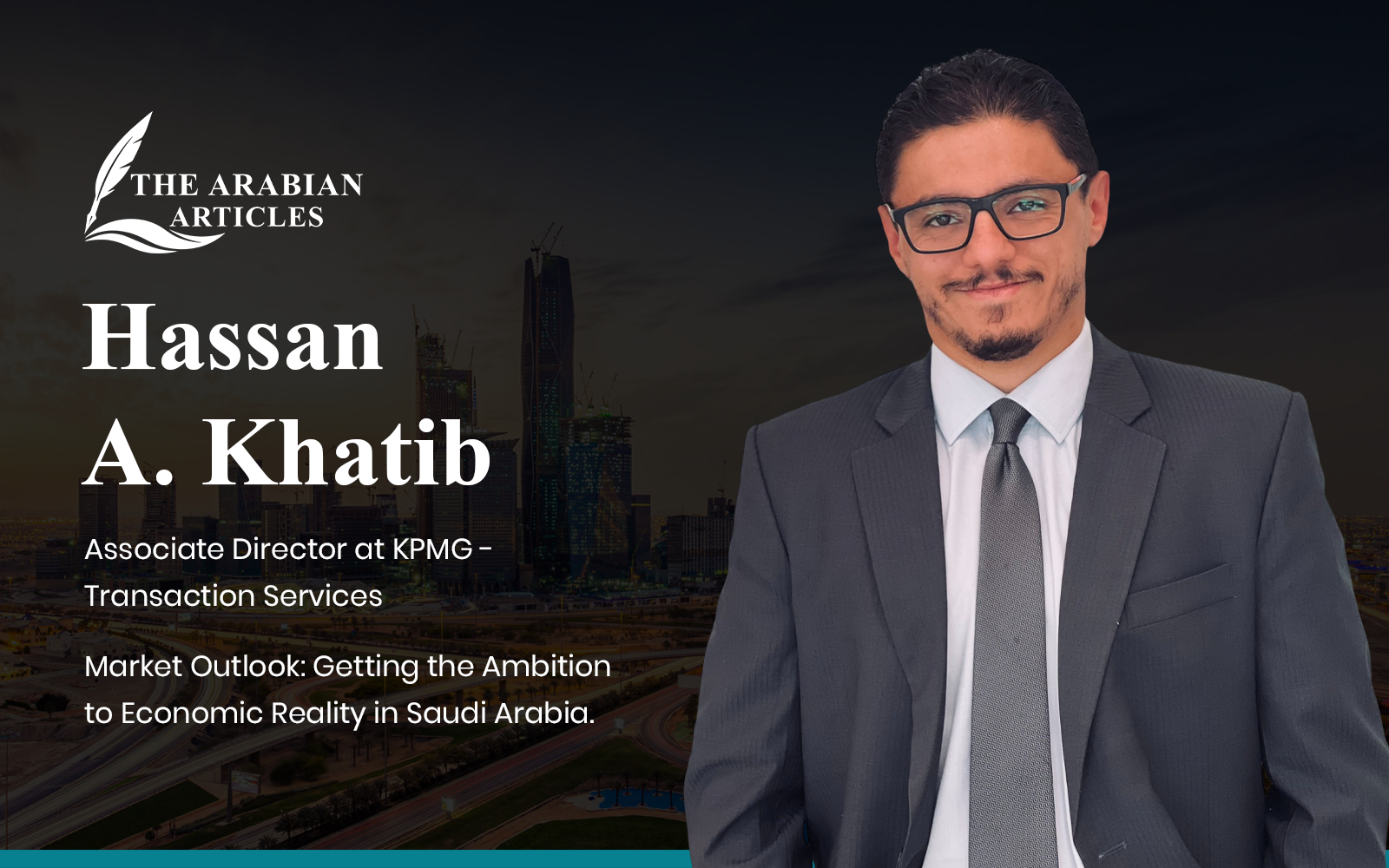

Hassan A. Khatib, the Associate Director in the Deal Advisory department of KPMG Saudi Arabia, believes that the Kingdom is on the brink of 2026. This Saudi Arabia Market Outlook 2026 highlights how Vision 2030 reforms, capital market growth, and non-oil sector expansion are shaping the Kingdom’s economic reality. The course has been established, and the aspiration is still there, but the next stage will be characterized by the effectiveness with which the policy objectives can be matched with the economic reality. As the world markets are still experiencing uncertainty, Saudi Arabia is entering this phase with a favorable background and the prospects of steady and well-balanced growth.
The liquidity in the system is good; capital markets have been more accessible and deeper than before, and valuation levels are still appealing as compared to those of international counterparts. Furthermore, the oil prices, which are volatile per se, are generally conducive, and the ongoing implementation of Vision 2030, currently well into its third year, offers structural plausibility to the long-term development story of the Kingdom. But nowadays it is not about ambition but about delivery, prioritization, and execution.
From Vision to Execution
In the long-term outlook, the growth momentum will improve as the massive infrastructure and development initiatives pick up pace. Under Vision 2030 Saudi Arabia, these mega projects are accelerating Saudi Arabia’s economic growth and strengthening the long-term Saudi economy 2026 outlook. The pipeline of projects that are associated with major global events and that the kingdom of Saudi Arabia is due to engage in over the next few years, such as Expo 2030 in Riyadh, the 2034 FIFA World Cup, and the 2027 AFC Asian cup is set to stimulate the investment activity in the various sectors in the kingdom.
These occasions are not mere milestones on a calendar. They are, however, influencing the urban development, increasing the pace of transport and logistics investments, and generating demand in the realms of construction, hospitality, retail, and services. Notably, much of this investment is planned with long-term economic usefulness in mind, so that the infrastructure that is created nowadays can be used to help the growth long after the occasions for which it was created.
The multiplier effects in terms of employment, supply chains, and involvement of the private sector will most likely become more noticeable as execution picks up, which will strengthen belief in the overall economic perspective.
Increasing Opportunity Set
In addition to infrastructure, the ongoing expansion of Saudi Arabia into new areas of development is starting to change the economy in a more significant fashion. Artificial intelligence, digital infrastructure, cloud, and innovative technologies are all underway and growing the economic base of the Kingdom and making it a regional innovation center. These investments reinforce the Saudi Arabia investment outlook by positioning the Kingdom as a regional hub for innovation and digital infrastructure.
Such investments do not simply concern the attraction of capital but rather building capabilities. With a concentration on technology, data, and digital platforms, Saudi Arabia is creating a foundation of productivity that can be used in the long term to be competitive. Simultaneously, tourism remains one of the critical sources of diversification. Moreover, the religious tourism is also an anchored service, and leisure, entertainment, and cultural provision are also scaling quickly to generate wider and more stable services.
Such efforts will result in continuous economic activity and not a single shot of growth as they grow up, which will make the growth become more sustainable.
Building Domestic Resilience to a Changing Global Environment
The domestic economic activity will continue to be robust up to 2026. This phase supports Saudi Arabia diversification and stabilizes the broader Saudi economy 2026 against global uncertainty. The consumer spending must continue to grow with the further improvement of the labor market conditions, the increase in the participation rates, and the households’ confidence. The expected reduction of interest rates will also be supportive, especially for the interest-sensitive sectors like real estate, manufacturing, and small and medium enterprises.
With this said, one of the risk factors is oil price volatility. Although the energy sector will probably revive at a slow pace, external shocks and fluctuations in global demand emphasize the need to continue the diversification. Moreover, it is necessary to maintain the expansion of non-oil priorities, which would help to save the macroeconomic stability and minimize the seasonality of the hydrocarbon dependence.
Positively, the structure of growth has become more well-rounded. Growth is becoming more based on business investment and consumption than on government spending; that is a more mature and stable economic model.
Non-Oil Growth Takes the Lead
Non-oil sector growth is becoming the core engine of Saudi Arabia economic growth under Vision 2030. Diversification under the Vision 2030 is still gaining momentum; the non-oil sector is likely to grow steadily at about 4.5 percent. This sector has now become the main engine of economic growth with the help of investment-based economic growth, as well as strong domestic demand.
Regulatory reform, access to better financing, and focused incentives are benefiting sectors like manufacturing, logistics, healthcare, education, financial services, and technology. The localization efforts are improving the domestic value chains, and the partnership with foreign players is contributing to skills transfer and efficiency in operations.
The increasing size and complexity of non-oil enterprises is also driving an upsurge in the activity of the capital market and a robust pipeline of IPOs, debt issues, and strategy deals.
Capital Markets and Direction of Policy
Policy-wise, 2026 will probably remain characterized by the need to expand funding sources and the capital market plunging. The expansion of Saudi capital markets is enhancing liquidity, transparency, and foreign investor confidence. The authorities are also supposed to increase efforts towards attracting foreign direct investment and increasing international involvement in local debt markets.
There has already been increased incorporation in the equity and fixed-income global indices, and this is bound to increase market liquidity and visibility. In the case of issuers, this will open them up to a wider investor base and competitive prices. It provides an investor with an opportunity to have exposure to a market that has reform momentum and has scale and growth potential.
Simultaneously, the current expansion of sukuk and the traditional bond markets is providing corporations and government-related bodies with increased flexibility in capital structure management. Capital markets are now being seen as a means of funding and also as a means of governance, transparency, and strategic positioning in the long term.
A Defining Phase Ahead
The greatest challenge as Saudi Arabia approaches the end of the decade will be to keep in line, balancing ambition and discipline, growth and sustainability, and leadership of the public sector and the involvement of the private sector. Scheduling of investments, prioritization, and continued implementation will also be crucial to the success of the next phase.
Despite this, the larger line is still quite strong. Saudi Arabia has had structural reforms, demographic tailwinds, and increased integration into global markets that make it one of the best growth stories in the region. The Saudi market of the year 2026 is not only a cyclical opportunity for both investors and businesses but also a long-term transformation that is becoming more credible with every passing year. Overall, the Saudi Arabia Market Outlook 2026 reflects a mature, diversified, and investment-ready economy.
About the Author
Hassan A. Khatib is an Associate Director in the Deal Advisory function at KPMG Saudi Arabia. He is a senior financial advisor with over 15 years of experience advising on high-value IPOs, M&A transactions, and capital markets mandates across the GCC. Also, Hassan has extensive exposure to investment banking environments and has led complex financial due diligence, deal structuring, valuation, and regulatory processes. He is a trusted advisor to C-suite clients and has worked closely with global investment banks on landmark regional transactions. He regularly contributes insights on the Saudi Arabia Market Outlook 2026, Vision 2030, and GCC economic outlook.
𝐒𝐭𝐚𝐲 𝐈𝐧𝐬𝐩𝐢𝐫𝐞𝐝: 𝐇𝐚𝐬𝐬𝐚𝐧 𝐀. 𝐊𝐡𝐚𝐭𝐢𝐛
𝐋𝐢𝐧𝐤𝐞𝐝𝐈𝐧 | 𝐊𝐏𝐌𝐆 𝐒𝐚𝐮𝐝𝐢 𝐀𝐫𝐚𝐛𝐢𝐚 | 𝐖𝐞𝐛𝐬𝐢𝐭𝐞
𝐑𝐞𝐚𝐝 𝐌𝐨𝐫𝐞 :-
𝐃𝐮𝐛𝐚𝐢’𝐬 𝐈𝐧𝐝𝐮𝐬𝐭𝐫𝐢𝐚𝐥 𝐑𝐞𝐚𝐥 𝐄𝐬𝐭𝐚𝐭𝐞 𝐈𝐬 𝐄𝐧𝐭𝐞𝐫𝐢𝐧𝐠 𝐚 𝐍𝐞𝐰 𝐖𝐨𝐫𝐥𝐝 𝐎𝐫𝐝𝐞𝐫
Broken Clocks, Booming Towers: Why Dubai’s Property Market Keeps Defying the Forecasts