



For decades, real estate professionals have repeated the same mantra:
Location. Location. Location.
It is quoted with such conviction that you would think it was carved into the first stone tablet handed to brokers.
And yet, most people who say it cannot clearly define what it actually means.
Because “location” is not a dot on a map.
It is a hierarchy.
It is position within position within position.
And once you understand that, the cliché collapses into something far more interesting — and far more strategic.
The Illusion of the Perfect Spot
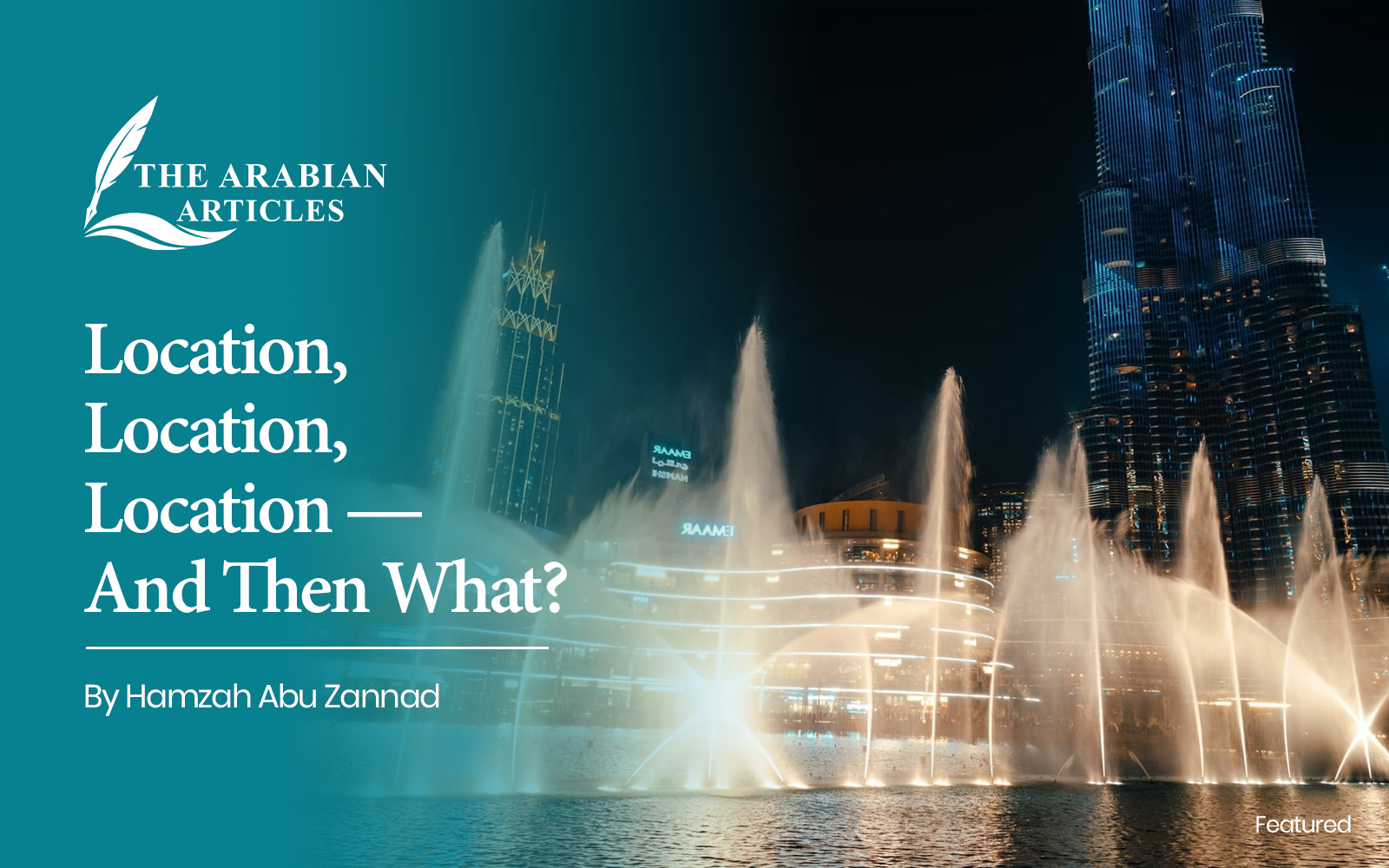
Take the most visited retail space in the Middle East:
The Dubai Mall.
Every retailer wants to be there.
But where?
- Near the fountain? Bravo.
- Lower ground? Upper level?
- Corner unit? Inline unit?
- 50 seats or 500 seats?
- Direct fountain view or partial exposure with double frontage?
Inside the mall is another economy of micro-locations.
Prime becomes relative.
The tenant paying a premium for “front row” might discover that 60% of the crowd is filming the fountain, not shopping.
In other words, proximity is not the same as performance.
When Bad Real Estate Becomes a Strategy
Consider the humble supermarket refrigerator.
For beer brands, fridge space is warfare. Eye level is gold. The back of the fridge? Exile.
Until one clever producer reframed the narrative:
“The back is six degrees colder.”
Instead of fighting for visibility, they claimed thermal superiority.
Then they engineered the mechanics so the product at the back would push forward into the side lane. What was once low visibility became engineered differentiation.
They did not improve the location.
They improved the interpretation.
The Exit That Prints Money
The Walt Disney Company perfected this long ago.
After every ride, visitors exit through the gift shop.
The corridor after the ride is technically a weak location. No one chooses it. No one lingers.
Yet it is monetized precisely because it captures the customer at the emotional peak of the experience.
The real estate did not change.
The timing did.
The Office Tower Paradox
In Grade A office towers, especially in markets obsessed with prestige, location becomes even more nuanced.
Near the elevator: visible and convenient.
Too near the elevator: noisy and chaotic.
Corner office: status symbol.
Southwest corner in Dubai: solar heat-gain nightmare.
So what is prime?
Not “Floor 23.”
It is:
Floor 23, northeast corner, 14 meters from the core, shielded from lift lobby traffic, with optimal daylight and minimal thermal penalty.
That is real estate literacy.
The Dead Table That Makes the Most Money
In restaurants, the “dead corner” table is often considered undesirable — away from foot traffic, slightly hidden.
Yet in high-end hospitality, those corners become VIP zones.
Privacy is monetized.
Isolation becomes exclusivity.
What was once weak positioning becomes premium inventory.
Why the Cliché Fails Leaders
The problem with “location, location, location” is that it encourages lazy thinking.
It suggests that value is fixed.
But value is rarely about macro-location alone. It is about:
- Flow of people
- Behavioral psychology
- Environmental conditions
- Timing within the customer journey
- Competitive adjacency
- Narrative framing
In other words:
It is not about where you are.
It is about what your position means.
The Strategic Upgrade
The smarter mantra would be:
Location within context.
Or, more bluntly:
There is no bad real estate.
Only poorly interpreted positioning.
Markets are full of “secondary” assets outperforming primary ones — not because they moved, but because someone understood how to reposition perception.
The vendor in the smaller unit near the fountain might outperform the 500-seat flagship if they engineer flow correctly.
The office slightly removed from the lift might sell at a premium if marketed as “executive privacy.”
The fridge space at the back might outsell the front if framed as colder, purer, better.
A Final Observation
Real estate professionals like to believe they are in the geography business.
They are not.
They are in the behavioral economics business — with walls.
And once leaders understand that, they stop chasing the obvious fountain view — and start engineering advantage from the overlooked corner.
That is when location stops being a cliché.
And starts becoming a strategy.
About the Author

Hamzah Abu Zannad is the Co-Founder and Managing Director of Axiom Prime Real Estate Development. With more than two decades of experience in Dubai’s real estate market, he has contributed to projects shaped by long-term thinking, disciplined planning, and sustainable growth.
At Axiom Prime, Hamzah has centered his work on low-density, community-focused luxury developments influenced by Dutch living principles — prioritizing walkability, light, and human-scale design. The company’s flagship projects in Jumeirah Village Triangle and Jumeirah Garden City reflect his belief that real estate should feel intentional, functional, and lasting — not just impressive.
With a steady, long-range view of Dubai’s evolution, Hamzah continues to contribute to the city’s changing urban fabric.
For more information, visit https://axiomprime.ae
𝐑𝐞𝐚𝐝 𝐦𝐨𝐫𝐞 :-